
KU’s Parklands Campus School of Law conducted the 15th Edition of the AKMCC (All Africa Kenya Moot Court Competition), bringing together passionate law students, legal professionals, and esteemed organisations in a five-day competition centred around “Tides of Change.” With pressing issues like safeguarding human rights in the digital era, the power of social media in good governance, and Kenya’s economic conditions taking centre stage, this year’s competition was set to break barriers and offer an exciting platform for Gen Z’s future legal advocates.

The five-day event promised to be a thrilling opportunity for law students to showcase their expertise while diving deep into the pressing issues of the day. From human rights to the digital era and the evolving role of social media in governance, this competition provided a space for the next generation of legal advocates to engage in thought-provoking debates.
This year’s competition raised the bar. Students were tasked with debating real-world issues such as the protection of human rights in an increasingly digital world, the impact of social media on national security and governance, and the economic challenges faced by Kenya. These were the kinds of issues that resonated deeply with Generation Z, who were poised to shape the future.


In addition to these vital topics, participants also addressed social issues, such as the intersection of technology and justice, the role of social media in good governance, and the broader implications of economic inequality. These issues were at the forefront of today’s legal landscape, and the students participating in AKMCC had the opportunity to offer practical solutions to these complex challenges.
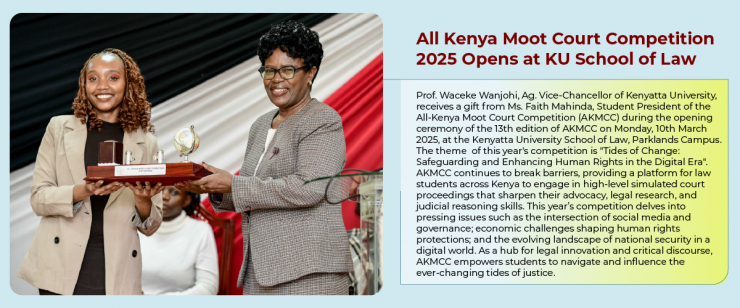
Faith Mahinda, a lead in the competition’s planning, introduced the steering committee, a group of 13 committed students who played a vital role in organising this landmark event. Mahinda also discussed the theme, ‘Tides of Change’ and its significance in the context of human rights today, especially in the digital age.
“The theme reflects the growing challenges and opportunities that come with a world increasingly shaped by digital technologies. It is essential to safeguard freedoms in this era of rapid technological advancement,” Mahinda shared. “This competition isn’t just about debating the law, it’s about advocating for a better, more just world.”
The importance of youth involvement in legal advocacy was emphasised by Dr. Stefanie Rothemberger, Director of the Konrad Adenauer Stiftung’s Sub-Saharan Africa Programme. Dr. Rothemberger highlighted the ongoing partnership between Kenyatta University and the Konrad Adenauer Stiftung, which had actively supported student-led initiatives for years.
“We have always been committed to supporting the youth in shaping justice systems,” said Dr. Rothemberger. “Kenyatta University’s students exemplify how the next generation can drive meaningful change and influence the discourse on human rights, good governance, and criminal justice.”

Dr. Rothemberger further praised the efforts of young legal advocates in Kenya, noting the positive impact they had had on global conversations surrounding legal reforms.
Mrs. Anne Mubia from Viva Africa LLP also offered her insights, applauding the students for their ambition and commitment. “Viva Africa LLP has long supported initiatives that help young people thrive in the legal field. I’m excited to see how these students will contribute to future changes in governance and justice,” she remarked.

Kenyatta University’s Acting Vice-Chancellor, Prof. Waceke Wanjohi, took the opportunity to reflect on the significance of the competition. “This is more than just a moot, it’s a training ground for future legal leaders. The issues being discussed today reflect the challenges our nation is grappling with, and it’s here that students will gain the skills needed to tackle them head-on,” Prof. Wanjohi stated.
She continued, “Kenyatta University is proud to serve as a platform for students to tackle real-world issues. We provide the experience necessary for them to thrive in the workforce, and this event is a testament to our commitment to shaping future leaders.”

The 15th Edition of the AKMCC was not only a significant event for Kenyatta University but also a crucial moment for the legal landscape of Kenya. By tackling pressing issues such as human rights, governance, and digital justice, the competition provided law students with the tools they needed to advocate for change, both locally and globally.
As the competition continued, students were not just learning the law, they were gaining the skills necessary to become advocates for justice. The future of Kenya’s legal system was indeed in capable hands, and through events like AKMCC, these future leaders were equipped to lead the charge in shaping a better tomorrow.