
What if having a voice in Kenya means far more than simply casting a vote every five years?
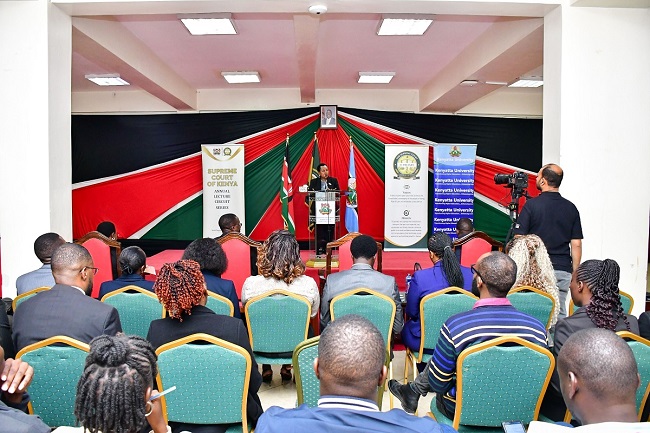
That question emerged as a powerful reflection during the Kenyatta University Lecture Circuit Series, where a conversation on public participation and constitutional governance offered a broader understanding of what it means to be an active citizen in a constitutional democracy.

Opening the event, the Ag. Deputy Vice-Chancellor (Academic), Prof. Bernard Kivunge, who represented the Vice-Chancellor, highlighted KU’s continued growth, including rising demand for its programmes and the introduction of new master’s programmes. He also underscored the University’s commitment to accessibility and inclusion, particularly in creating opportunities for students with disabilities to participate fully in university life.
His remarks also challenged students to ask questions, think critically and make meaningful use of the opportunities available to them; values that closely align with the broader purpose of public participation.

The keynote presentation by Hon. Lady Justice Philomena Mwilu, EGH, Deputy Chief Justice and Vice-President of the Supreme Court of Kenya, placed the discussion within the wider context of the country’s constitutional journey.
Tracing the evolution of public participation in Kenya, Justice Mwilu highlighted the limitations citizens faced under the independence Constitution, where opportunities to influence governance beyond elections were comparatively limited. The repeal of Section 2A of the Constitution in 1991 restored multiparty politics, creating greater space for political competition and public discourse.
The establishment of the Constitution of Kenya Review Commission in 2000 marked another significant stage in this journey, providing Kenyans with opportunities to contribute to constitutional reform through public hearings and submissions.
The 2010 Constitution fundamentally strengthened this relationship between citizens and the State by affirming that sovereign power belongs to the people. Article 10 further recognises public participation as a national value and principle of governance, placing citizen engagement at the heart of Kenya’s constitutional order.
This means participation does not end at the ballot box.
It extends to engaging with legislation and public policy, contributing to discussions on the allocation of public resources, demanding accountability and participating in decisions that affect communities and the country at large.
For university students in particular, this understanding presents public participation not simply as a constitutional provision, but as a civic responsibility. Asking informed questions, engaging in public discourse, challenging ideas respectfully and seeking to understand how institutions function are all part of building a more informed society.
The Lecture Circuit therefore offered more than a historical account of Kenya’s constitutional development. It created a space for reflection on the relationship between citizens, institutions and governance,reinforcing the role of universities as platforms for knowledge, dialogue and critical civic engagement.
Ultimately, democracy is not exercised only on election day. It is sustained through citizens who remain informed, participate meaningfully and understand that their voice can influence public affairs long after the ballot has been cast.