

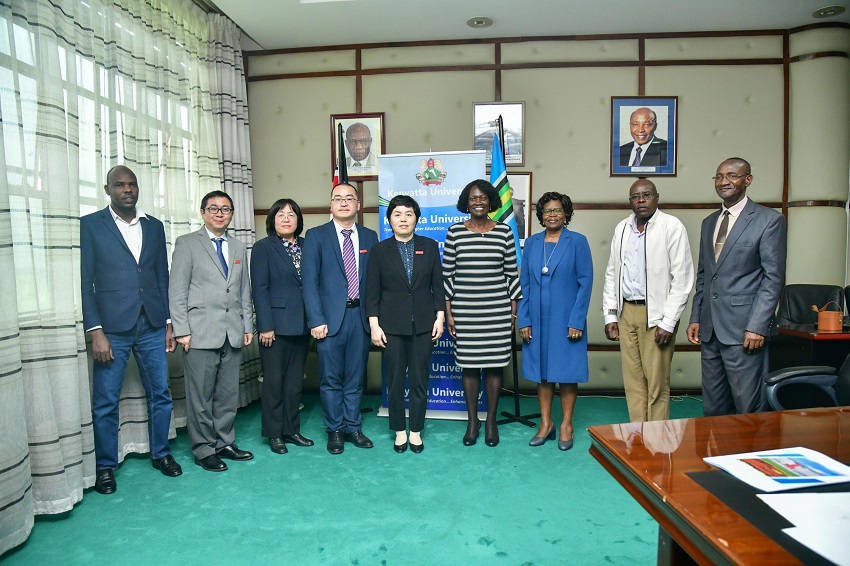
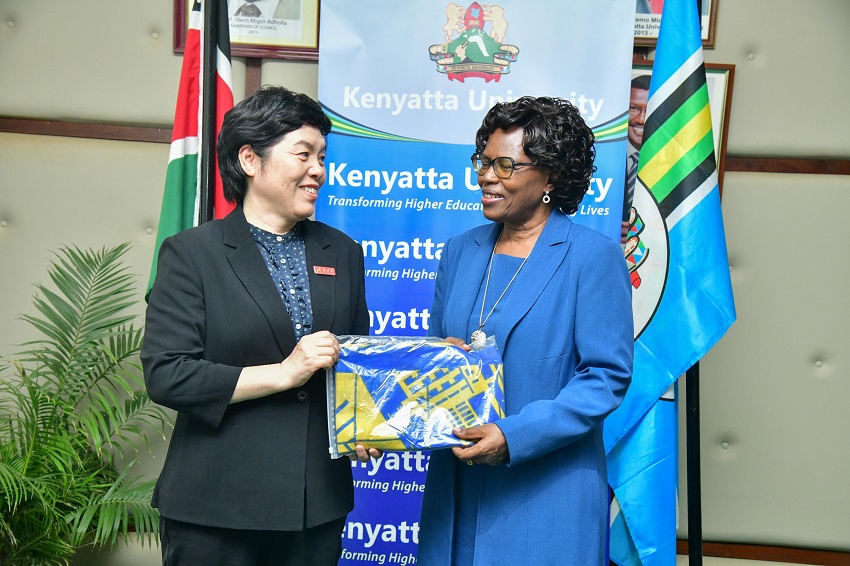
Kenyatta University hosted a delegation from the University of Jinan (UJN), China, led by Mrs. Liu Chunhua, Chancellor of the University of Jinan, who paid a courtesy call on the Vice-Chancellor, Prof. Paul Wainaina. The Vice-Chancellor was represented by Prof. Caroline Thoruwa, Deputy Vice-Chancellor for Research, Innovation and Outreach (RIO).
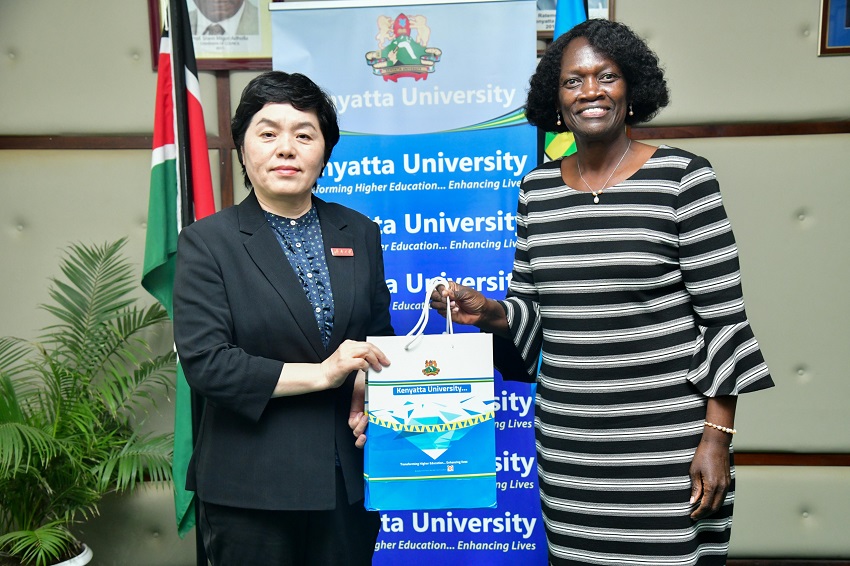
The visit marked yet another significant step in strengthening Kenyatta University’s internationalisation agenda and advancing bilateral partnerships with leading global institutions.
The UJN delegation comprised senior university executives including Wang Ping, Director of International Affairs; Wang Lin, Dean, School of Information Science and Engineering; Qin Xiaochun, Dean, School of Biological Science and Technology; Chen Gongxiang, Dean, School of Education and Psychology and Hou Pengkun, Vice-Dean, School of Materials Science and Engineering. They were received by a KU delegation led by DVC (Academic) Prof. Waceke Wanjohi, Executive Dean, School of Engineering and Architecture Prof. David Minja, Confucius Institute (C.I) Director Prof. Leonard Chacha, and lecturer at C.I Ms. Luo Duoduo.
A University with Complementary Strengths
With a history spanning more than 70 years, the University of Jinan is one of China’s distinguished institutions originally founded to spearhead training in building materials engineering. Today, it is among the top five universities in China under the Ministry of Construction and Building Materials, offering a comprehensive suite of programmes across 21 schools and serving more than 38,000 full-time students.
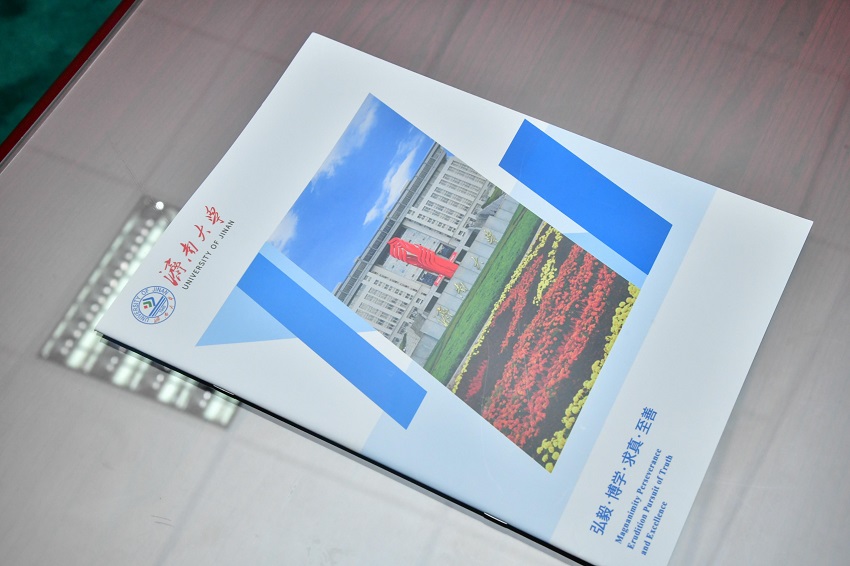
Its academic strengths including materials science, hydrology and water resources engineering, network-based intelligent computing, chemical materials, tourism management, nutrition and culinary sciences, and education psychology speak directly to areas of growth within KU’s School of Engineering and Architecture, School of Pure and Applied Sciences, School of Hospitality and Tourism, and School of Education.
Both institutions share notable similarities:
- They are public universities supported by their respective governments.
- They prioritise research-driven innovation, capacity building, and technology-led collaboration.
- They host communities committed to internationalisation, multicultural engagement, and global academic mobility.
These parallels form a strong foundation for impactful cooperation.
Charting a Vision for Collaboration
Discussions during the meeting centred on several strategic fronts that would significantly enrich both campuses:
1. Academic Exchange and Joint Graduate Training
UJN expressed a strong interest in co-developing joint Master’s programmes, particularly in:
- Materials Science and Engineering
- Computing and Intelligent Systems
- Applied Psychology and Special Education
- Education Administration
Additionally, the delegation proposed co-supervision of postgraduate students, a move that would elevate the quality of research output and international exposure for KU students.
2. Strengthening Cultural and Linguistic Ties
The presence of KU’s Confucius Institute continues to anchor Sino-Kenyan educational relations. KU is currently advancing efforts to roll out a Master’s programme in Chinese Language and Culture, with UJN positioned as a key academic partner.
With UJN’s experience in training international students from over 16 countries, KU students studying Chinese language and culture will now have an expanded opportunity to pursue overseas study, exchange, and short-term immersion programmes in China.
3. Joint Research Laboratories and Innovation Hubs
UJN runs advanced research laboratories specialising in:
- Low-carbon technologies
- Fluoride chemical materials
- Network-based intelligent computing
- Materials science
These areas align strongly with KU’s research agenda, particularly in engineering, environmental science, and applied sciences. Discussions emphasised establishing joint research laboratories, scholarly exchanges, and co-authored publications leveraging both institutions’ research ecosystems.
4. Building Industry-Linked Academic Ecosystems
The delegation highlighted the role of multinational companies operating in Kenya, many of which have parent companies in China, in supporting research and student mobility. Such partners have expressed readiness to contribute to collaborative initiatives creating pathways for internships, apprenticeships, and industry-focused research between KU and UJN.
Institutional Reflections and Commitments
DVC (Academic), Prof. Waceke Wanjohi, affirmed the University’s readiness to operationalise the partnership: “We agree fully that we can do a lot together, especially in materials science. What is important now is to move from discussion to action so that this collaboration yields tangible outcomes.”
Executive Dean, School of Engineering and Architecture, Prof. David Minja, echoed this direction: “We can progress towards an MoU if we do not have one already. If one exists, then it is definitely time to elevate it to an MoA. At KU, we are intentional about building partnerships that deliver real value.”
Representing the Vice-Chancellor, DVC (RIO), Prof. Thoruwa, lauded the collective enthusiasm, emphasising the need for faculty-to-faculty engagements that will anchor the partnership at the operational level: “Our teams must now link up and move this to the grassroots. The potential here is enormous.”
A Partnership with Vision
The University of Jinan expressed confidence that, through mutual effort, its collaboration with Kenyatta University can grow into a model for Africa–Asia academic engagement. KU was invited to undertake a return visit to Jinan to deepen negotiations and explore additional areas of collaboration.
With both institutions anchored in strong government support, global linkages, and disciplinary intersections in the sciences, engineering, education, and culture, the partnership promises to create transformative pathways for:
- Student mobility
- Joint degrees
- Cultural immersion
- Cutting-edge research
- Interdisciplinary innovation
As KU continues to expand its international engagements, partnerships such as this one affirm the University’s commitment to positioning itself as a leading global institution, one that connects Kenya to the world through education, research and shared scholarly purpose.