
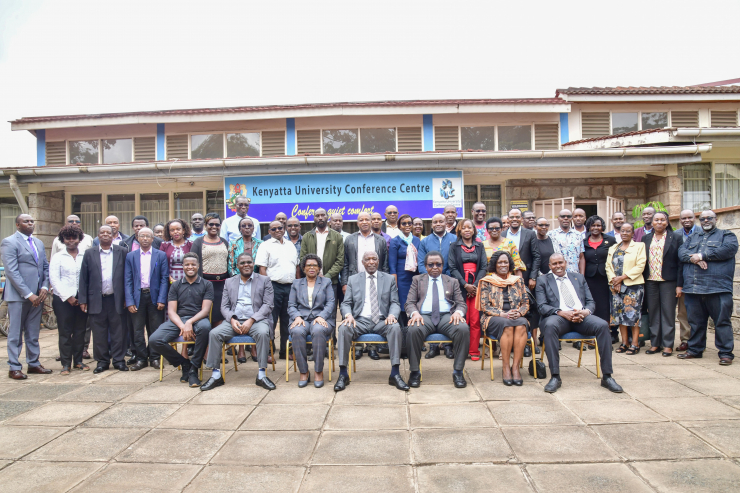
Kenyatta University recently hosted a high-impact workshop themed “Use of Generative Artificial Intelligence to Enhance Teaching, Learning, Research, and Innovation.” The event brought together academic leaders, faculty, and tech experts to explore how AI can be ethically and effectively integrated into educational and research ecosystems in Kenya and beyond.
The session opened with the singing of the National and East African Anthems, followed by a reflective prayer that set a solemn and unifying tone for the day’s discussions.
Dr. Erick Araka kick-started the presentations with a compelling demonstration on the practical applications of generative AI in academia. He showcased tools designed to support student learning by generating notes and questions, and emphasised the growing importance of prompt engineering as a vital skill for optimising AI output. Dr. Araka also underscored the urgency of stakeholder collaboration in formulating policies to govern the ethical use of AI, ensuring students are empowered to interact with AI tools responsibly.
Prof. Benard Kivunge, Registrar Academic, stressed that the adoption of AI is no longer optional. “The world must embrace AI, ethically,” he said. His sentiments were echoed by Deputy Vice-Chancellor (Academic), Prof. Waceke Wanjohi, who emphasised the importance of institutional readiness and proactive collaboration for effective AI integration.
“AI is rapidly transforming how knowledge is created and shared,” Prof. Wanjohi noted. She advocated for embedding principles of responsible AI use within student support systems and university leadership, adding, “If you don’t change, change will change you.”
Vice-Chancellor, Prof. Paul K. Wainaina, officially opened the conference. In his keynote remarks, he welcomed attendees and emphasised that tools like ChatGPT, Gemini, and DeepSeek are revolutionising content creation and offering unprecedented opportunities for personalised, interactive learning.
However, Prof. Wainaina also raised essential concerns around authenticity, academic integrity, and ethical usage. He urged institutions to create clear, forward-looking policy frameworks on AI. “While machines generate content, it is people who give it meaning,” he remarked, calling on educators and researchers to question assumptions, share insights, and safeguard academic excellence.
Delivering the main keynote address, Prof. Elizaphan Maina, Executive Dean of the Digital School of Virtual and Open Learning (DSVOL), celebrated KU’s recent strides in tech-driven education, including the introduction of a PhD in Computer Engineering. He outlined AI’s transformative potential across education, framed around its four foundational pillars:
- Thinking humanly
- Thinking rationally
- Acting humanly
- Acting rationally
Prof. Maina advocated for a shift in pedagogy, embracing problem-based, project-based, and collaborative learning, arguing that generative AI should be integrated in ways that support personalised learning, enhance assignment creation, improve student assessment, and enable real-time feedback.
He concluded his address with a set of critical questions for academia to reflect upon:
- Can we mitigate algorithmic bias?
- What are the implications for copyright and employment?
- How will AI influence misinformation and public policy?
- Will it come to grips with its cost?
- Will doomerism continue to dominate policy-making?
The workshop concluded with a renewed commitment to developing a well-informed community of practice dedicated to the responsible use of AI in research, education, and innovation. Kenyatta University reaffirmed its mission to lead with ethical foresight, offering institutional guidance that ensures the preservation of academic integrity in a rapidly changing technological landscape.
As AI continues to evolve, Kenyatta University remains unwavering in its resolve to be a beacon of ethical innovation, research excellence, and transformative education.