
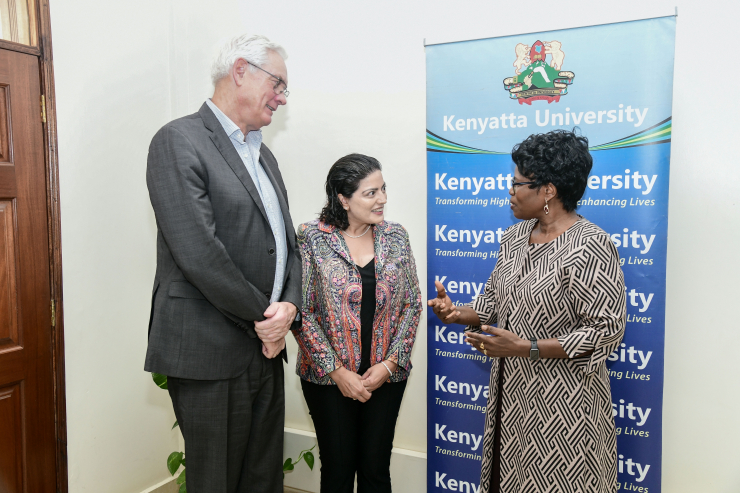

A delegation of two led by Professor Tavneet Suri of the Massachusetts Institute of Technology (MIT) paid a courtesy call to the Acting Vice-Chanellor, Prof. Waceke Wanjohi. The meeting focused on harnessing the power of digital education, through the recently awarded Abdul Latif Jameel Water and Food Systems Lab (J-WAFS) Grand Challenge project “Food Security in Africa through Microbiome Engineering” marking an exciting new chapter in the collaboration between MIT and Kenyatta University. The partnership aims to tackle the pressing issue of access to higher education across Africa, with Kenyatta University set to become a cornerstone of MIT’s efforts in broadening educational opportunities for the continent.
Professor Robert Van Der Hilst, part of the duo, discussed the potential for leveraging digital learning to increase accessibility and improve the quality of education. MIT’s Open Learning platform, alongside collaborations in West Africa, sets the stage for an innovative project that could transform how Africa’s rapidly growing population engages with education.
Highlighting the success of Kenyatta University’s efforts in virtual and blended learning, through the Digital and Virtual School of Open Learning Prof. Wanjohi emphasised the institution’s leadership in educational planning in the region. With strong ties to UNESCO and ongoing collaborations with other universities across Africa, Kenyatta University is well-positioned to benefit from this groundbreaking initiative.
Professor Tavneet Suri, an economic expert in the role of technology in Sub-Saharan Africa, discussed MIT’s ongoing work to address the challenges of educational access and quality. She noted that in regions like West Africa, localising content and creating contextually relevant learning modules is essential for making education more relatable and impactful.
Kenyatta University’s use of blended learning strategies and its ongoing work to develop a curriculum for sustainable development makes it a natural partner for this ambitious project. With a proven track record of integrating technology into education, KU is leading the way in demonstrating how technology can improve student retention and learning outcomes.
The partnership also aims to improve capacity building, furthering KU’s reputation as a pioneer in educational transformation, and ensuring that the benefits of digital education reach across Africa, breaking down barriers and creating more opportunities for the continent’s youth.
The courtesy call and discussions with MIT solidified a shared commitment to improving educational access through digital learning. As KU continues to innovate and expand its digital offerings, this collaboration promises to reshape the landscape of higher education in Africa.