
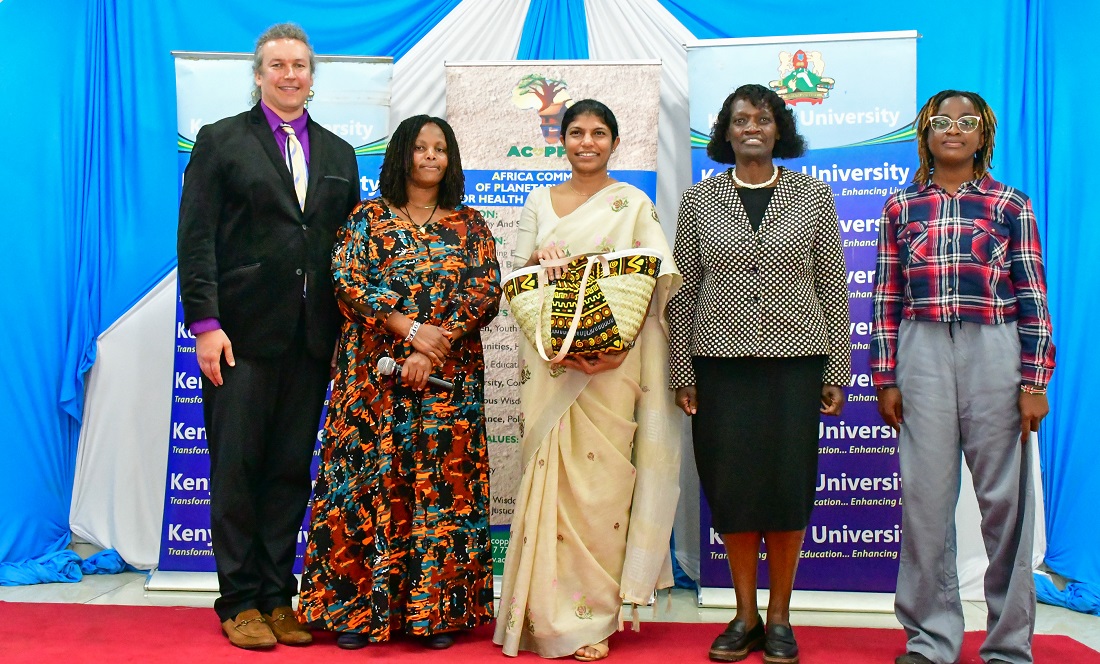
Kenyatta University has reaffirmed its commitment to advancing collaborative solutions to climate change through the opening of the 2nd African Universities and Communities Climate Week (AUCCW 2026). The engagement brought together university leaders, researchers, community representatives and development partners to strengthen collective action towards healthier, more resilient communities across Africa.

Held under the spirit of “One Health, One Planet,” the Climate Week highlighted the interconnectedness of human health, environmental sustainability and community wellbeing. It provided a platform for universities and communities to exchange knowledge, strengthen partnerships and translate research into practical solutions that respond to the realities of climate change.
Speaking during the opening ceremony, Dr Ezekiel Ndunda, Chairperson, Department of Environmental Science and Education and Co Chairperson of the JIC AUCCW 2026, called for stronger partnerships and clearly defined objectives in advancing climate action. He emphasised the importance of bridging urban and rural divides, integrating indigenous knowledge systems into climate solutions and promoting green approaches that support sustainable development.
Dr Nathaniel Uchtmann, Executive Director, African Community of Planetary Platform for Health and Environment (ACOPPHE) and Co Chairperson of the JIC AUCCW, highlighted the initiative’s role in strengthening connections between African universities and communities. He underscored the importance of preserving community languages, values and knowledge while creating platforms that promote collaboration, knowledge exchange and planetary health.
Representing the Executive Dean, School of Agriculture and Environmental Sciences, Prof. Maina Mwangi, Dr Mwende Ngie observed that climate change cuts across academic disciplines and called on universities to play a leading role in strengthening community resilience. She emphasised the need for interdisciplinary approaches that bring together knowledge and expertise from different fields.

Representing the VC, Prof. John Okumu, DVC (Research, Innovation and Outreach), Prof. Caroline Thoruwa reaffirmed the University’s commitment to addressing climate change through research, innovation, collaboration and meaningful community engagement. She emphasised the importance of translating research into practical solutions while empowering communities and young people to take an active role in climate action.
The Chief Guest, H.E.S. Ruvini S. De Silva, Ag. High Commissioner of Sri Lanka to Kenya, emphasised that climate change requires collective action, noting that its effects extend beyond the environment to public health, food security and community livelihoods. She highlighted the impact of droughts and floods and stressed the importance of protecting biodiversity as a foundation for sustainable food systems.
She challenged universities to remain centres of discovery and innovation capable of generating solutions to emerging global challenges. She further emphasised that a sustainable future cannot be built in isolation, calling for greater collaboration among universities, communities, governments and development partners.
H.E.S. De Silva officially opened the 2nd African Universities and Communities Climate Week 2026, setting the stage for continued dialogue, knowledge exchange and collaborative action towards a healthier, more resilient and sustainable Africa.